
Report from a special virtual forum Advancing Climate-Smart Trade and Finance, exploring value-building international cooperation to drive sustainable human development
Article 6.8 of the Paris Agreement calls for international cooperation to accelerate climate action, across multiple dimensions, without emissions trading. It effectively invites multilateral agreements that mainstream climate action across the whole economy—advancing climate-smart trade and finance.
On Wednesday, March 19, 2025, CCI and the Climate Value Exchange partners hosted a special virtual forum to review and discuss Article 6.8 activities that can start working in 2025, to improve lives and livelihoods.
The project of mainstreaming climate action is by its nature layered, cooperative, and involves scaling innovative business models across diverse economic conditions. It is also about ensuring more people have access to quality services and products that make their lives easier, improve affordability and clean development, and create opportunities for new local investment and job creation. Trade is a scaling mechanism, opening new productive capacity and new markets to expand the investability of innovative solutions.
Even with trade wars looming, and related economic uncertainty imposing early and potentially long-running costs, the opportunity to use trade to build momentum for a climate-smart future is real and immediate. Our special virtual forum highlighted examples of leadership that can build value across the economy, including for marginal and vulnerable communities and for industries affected by transformational policy and innovation.
A headline takeaway from the discussion is that multidimensional climate cooperation can improve lives and livelihoods, while reducing climate risk and building climate value. Such cooperative arrangements are not only strong candidates for improved deployment of climate-related finance; they are means of mainstreaming and, by extension, rapidly scaling climate-smart financial innovation.
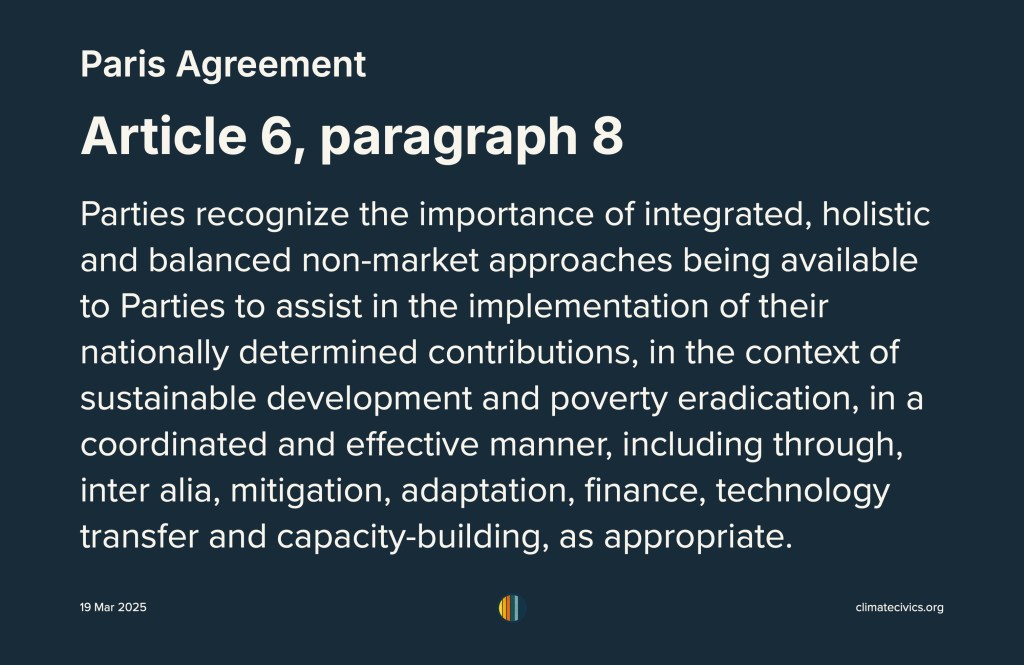
We reviewed the language of Article 6, paragraph 8 of the Paris Agreement, in detail.
Parties recognize the importance of integrated, holistic and balanced non-market approaches being available to Parties to assist in the implementation of their nationally determined contributions, in the context of sustainable development and poverty eradication, in a coordinated and effective manner, including through, inter alia, mitigation, adaptation, finance, technology transfer and capacity-building, as appropriate. These approaches shall aim to:
(a) Promote mitigation and adaptation ambition;
(b) Enhance public and private sector participation in the implementation of nationally determined contributions; and
(c) Enable opportunities for coordination across instruments and relevant institutional arrangements.
Then, we explored a series of concrete areas of opportunity linked to “non-market approaches” to international cooperation.









Agenda
- Review of Article 6.8 of the Paris Agreement
- Review of Existing and Emerging Non-Market Approaches
- Focused discussion on mainstreaming timelines in key sectors, including:
- Adaptation and resilience
- Energy and decarbonization
- Food systems
- Nature restoration and biodiversity recovery
- Shipping and distribution
- Urban-rural cooperation
- Moderated discussion
Preliminary list of actionable priorities
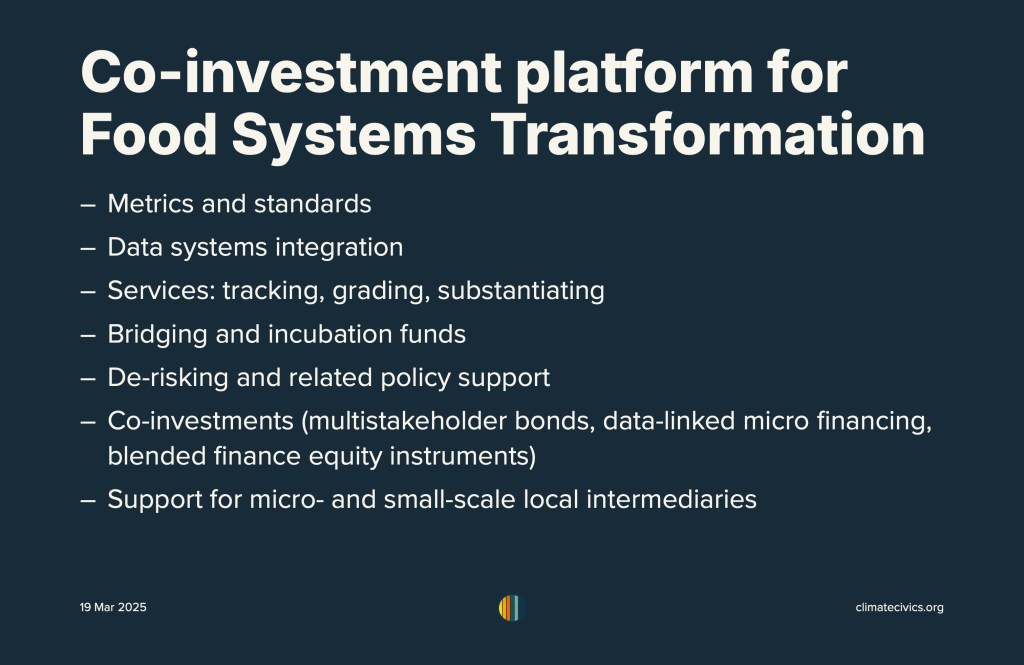
- A global co-investment platform for food systems transformation, aligned with climate goals and focused on revitalizing and diversifying marginalized, under-resourced, and unsustainable rural economies;
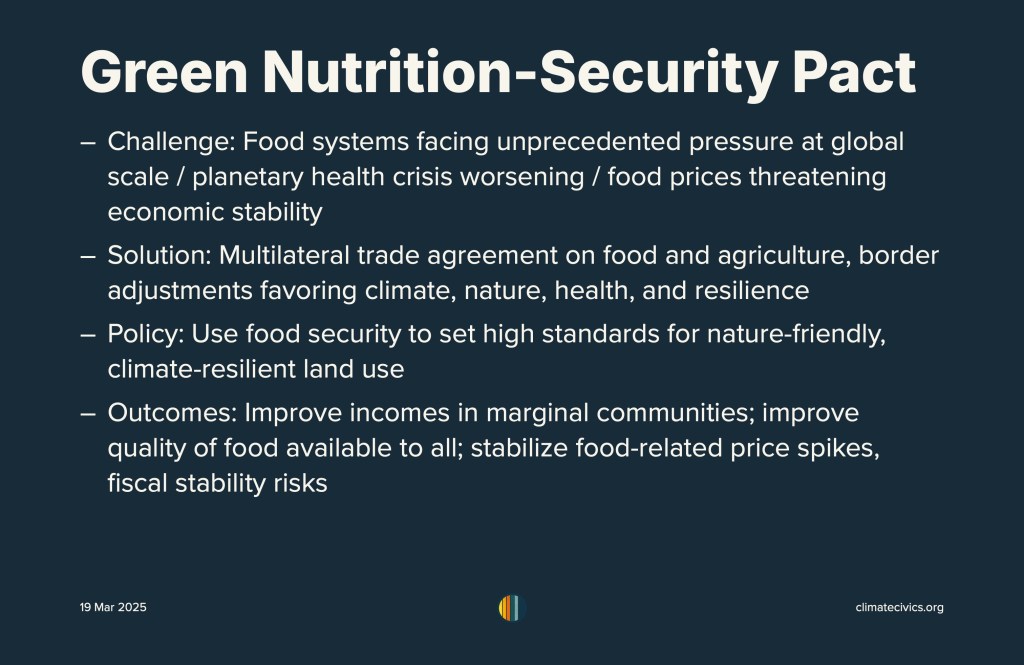
- Negotiated climate-smart trade agreements, aligned with the PARIS Principles and allowing each nation to reduce future dependence on polluting practices, while building a green economy;
- The Climate Value Exchange, intended to serve as a cooperative insight-sharing and policy innovation platform, to support non-market cooperation that builds value locally and across whole economies;
- Accelerated innovation timelines, including for integrated data systems aimed at providing real-time multidimensional performance tracking for mainstream investment activities;
- A Fossil Fuel Non-Proliferation Treaty, or similar agreed cooperative framework for the needed transition away from fossil fuels in energy systems.
(Report continues below)
Trade & Finance Reading
Explore our interactive resource library on elements of and policies that can advance Climate-Smart Trade and Finance.
Co-Investment, Spreading Good Practices
Looking at the Co-Investment Platform more closely, we identified several key ingredients of an effective climate-smart trade collaboration:
- Shifting of policies and incentives to unlock investment across sectors (public, private, multilateral, and philanthropic);
- De-risking and bridging support, through targeted allocation of funds to support private investment and reward innovators;
- Multidimensional metrics—to grade and track performance of non-financial value creation, and to guide decision-making;
- Financial innovation through MSMEs, letting local ventures deliver finance and data services that reinforce value chains;
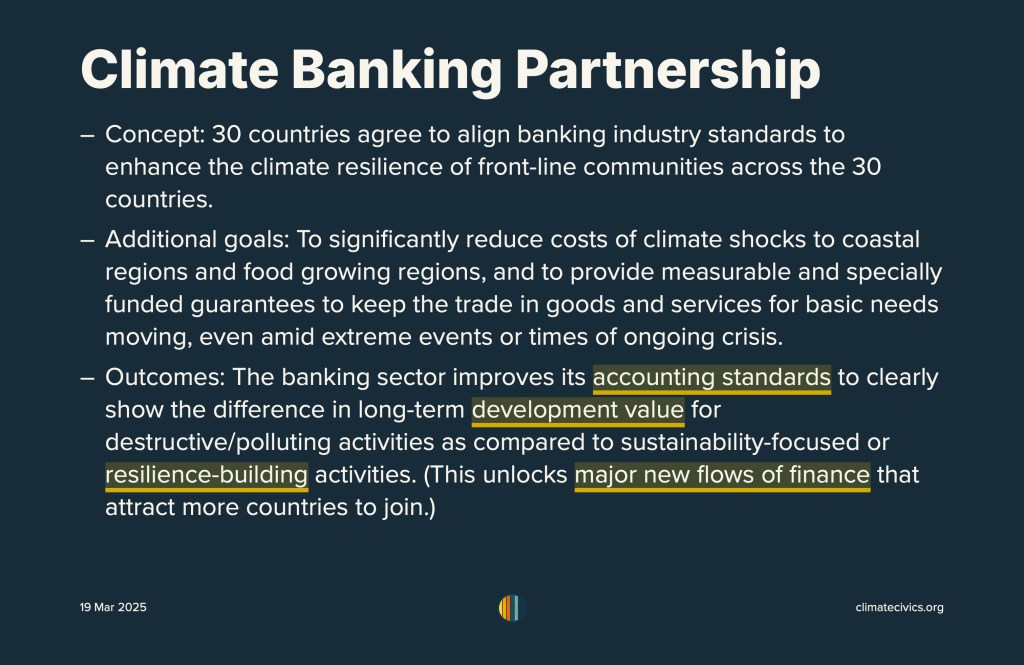
- Mainstream banking innovation, to allow capital from co-investments to flow to the whole value chain.
We also discussed how sustainable and resilience-building innovation can allow for spreading benefits of these new investments. We can treat natural systems as integrating structures that invite improvements and can support better livelihoods and outcomes across the whole economy. For instance:
- The ocean comprises the vast majority of both the climate system and the biosphere. Carbon-based life and healthy ocean ecosystems help to prevent heat-trapping carbon compounds from accumulating in the atmosphere and causing out of control global heating. Any waste from human activities on land makes its way through watersheds down to the ocean.
- To protect the global ocean and give ourselves a foundation for climate-resilient development, we need all industries to move toward practices that avoid harmful pollution and ocean breakdown.
- A group of countries could advance this standard, with clear benefits for economic, environmental, and fiscal health and stability, by agreeing to advance new practices that reduce pollution and related impacts from summit to seabed.
Such an Ocean-Smart Industries (OSI) Trade Area creates important opportunities for activating concrete financial innovations that can bring new investment to communities both near and far from the ocean. Participating countries could also work together to apply OSI standards to broader trade and investment activities, to consolidate their own positions of leadership, spread better practices, and reduce the cost of nature loss and climate disruption.
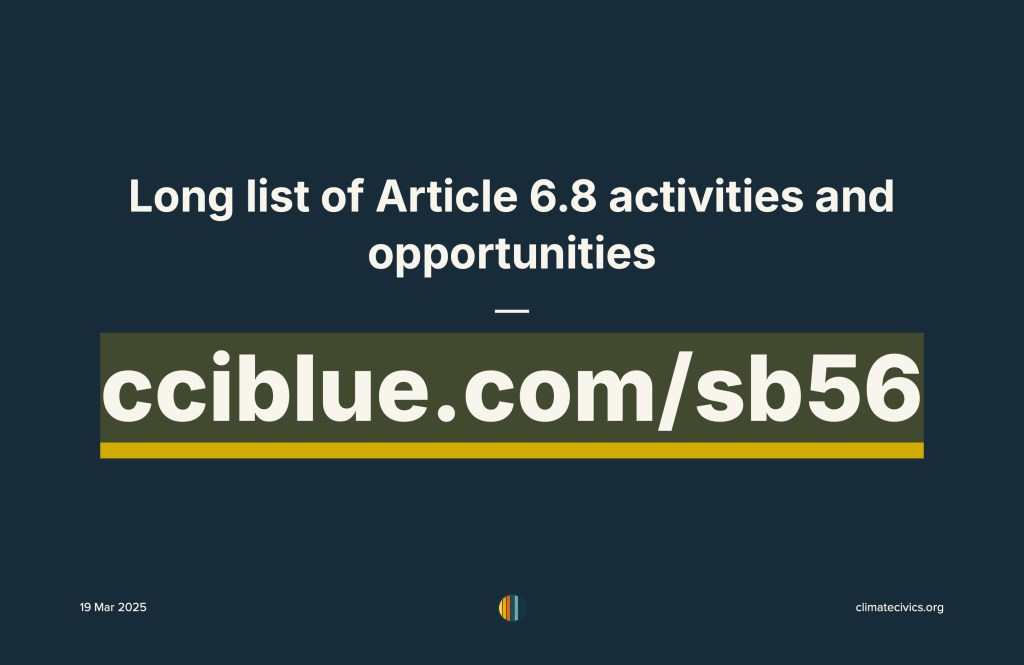
And, we shared the Long List of Non-Market Approaches outlined by national negotiators and other stakeholders for the SB56 round of UN Climate Change negotiations, in 2022.
An Entrepreneurship Ecosystem
Insurance is becoming an important driver of climate-related innovation and investments aimed at reducing risk and building resilience. As major insurers and reinsurers increasingly decline to provide coverage of certain kinds in certain affected regions and localities, alternative approaches to de-risking and protection of personal and shared assets are needed.
One option is parametric insurance, which is creating the possibility for lower-income communities to secure focused coverage in case of shock events. As the World Economic Forum reports:
Parametric insurance offers rapid, flexible payouts based on pre-defined triggers such as rainfall or wind speed, bolstering transparency and resilience in vulnerable communities.
Coastal communities are starting to explore this kind of option, when standard insurance policies are not available for homes, businesses, and municipalities. In Colombia, farmers are also able to access parametric insurance at low cost, to secure limited payouts if certain agreed trigger conditions occur. This can allow for response in case of harm, and could also allow for investment to build resilience, if climate pressures reach a certain threshold.
A core principle of climate-smart trade is that trading partners should align policies and incentives to make such opportunities more accessible and affordable. This can then also benefit the wider climate risk reduction project, by spreading resilience measures through participating and affected value chains.
We heard Article 6.8 non-market approaches described as an entrepreneurship ecosystem—a collective fabric of interactions that facilitate more robust, visionary, and value-building enterprise. Aligning of policies and sharing of insights are critical to success in building such an ecosystem.
We closed the session with this insight:
The great challenge of this century is distilling very complex wicked problems down to clear insights and actionable priorities that change what is possible.
The future of trade must be climate-smart, or losses to the world economy, and to quality of life in local experience, will be too great to count in dollar terms. The burgeoning atmosphere of trade war is not the best way to start down the road of multidimensional climate cooperation, but the risk of accelerating climate breakdown means those that lead the cooperative resilience revolution will see consistent benefits far into the future.
 Blue Notes